Preparing a property for photography is not about making every room look perfect. It is a matter of helping the space communicate clearly.
There is a moment on many property shoots when someone says, “It only needs a few pictures.”
I understand the instinct. The rooms already exist. The furniture is in place. The photographer arrives, finds the angle and presses the shutter.
Yet the strongest pictures rarely begin there.
They begin with a slow walk through the property. Looking at how one room leads into another. Noticing where the eye stops, where a surface feels empty, where an object competes with the architecture, and where a small intervention could make a room’s purpose immediately legible.
That work can be almost invisible in the finished image. It is also one of the reasons the image works.
A room can be complete and still not be ready for the camera
We recently photographed three residential properties in Kensington and Holland Park for Managed By, a company that works with owners and investors in prime Central London.
The brief was not simply to document the rooms as we found them. For the two Holland Park properties, Colette Hamilton-Davies asked us to shape the presentation using what was available. The Kensington property posed a different challenge. It was brand new and completely empty, so she asked us to help source the objects needed to dress its kitchen, bathroom and dressing room.
This is where photography becomes a production.
A room arranged for everyday life is experienced gradually and from many positions. A photograph compresses that experience into a single frame. Objects that feel harmless in person can disrupt the composition. A generous surface can appear strangely vacant. A dressing room without garments may describe its dimensions, but not the life it was designed to support.
Styling for the camera is therefore not the same as decorating a home. The purpose is not to impose a new identity. It is to clarify the identity already present.
We start by reading the space
Before sourcing anything, we look.
What does the architecture want us to notice? Which materials should lead? Where does the light naturally settle? What is the room for, and what would help a viewer understand that without explanation?
During a first reconnaissance, we photograph the rooms as working references. We then mark those images with practical decisions: remove this, soften that, introduce height here, add a sign of use there. The notes become a shared plan before time and budget are committed.
This step matters because an attractive prop is not automatically the right one.
The colour may be too dominant. Its scale may distort the room. A cluster of objects may make a kitchen feel smaller. Too many personal details can turn a property image into somebody else’s story. Too few can leave it feeling uninhabited.
The judgement lies in finding the point at which the property feels considered yet believable.
Reconnaissance photo with styling and camera annotations
Sourcing is part of production, not an afterthought
For the empty Kensington property, our production designer and stylist, Tara Clark, developed a practical sourcing list.
The kitchen needed kitchenware and food. The bathroom needed accessories. The dressing room needed garments. Each choice had to work not only as an individual object but also as part of a wider palette of colour, texture, proportion and use.
Depending on the commission, items may be:
purchased by the client;
hired from a prop house;
temporarily supplied by a stylist;
bought with an agreed return plan;
delivered and collected at additional cost.
None of these routes is complicated when it is planned. All of them become difficult when they are treated as a shoot-day surprise.
The sourcing budget, approvals, delivery windows, responsibility for returns and contingency options should be agreed early. This protects the client’s time and allows the creative team to concentrate on the image rather than improvising around missing pieces.
Prop sourcing schedules
Sometimes the smallest intervention does the most
The two Holland Park properties required a different approach. There, we worked with Paul Cripps, an interior and film-set stylist, to arrange what was already on location.
No wholesale transformation was needed. We adjusted placement, reduced visual noise and sought the few details that would bring balance and purpose to the frame.
This is often the more demanding judgement. Adding objects is easy. Knowing when the room has enough requires restraint.
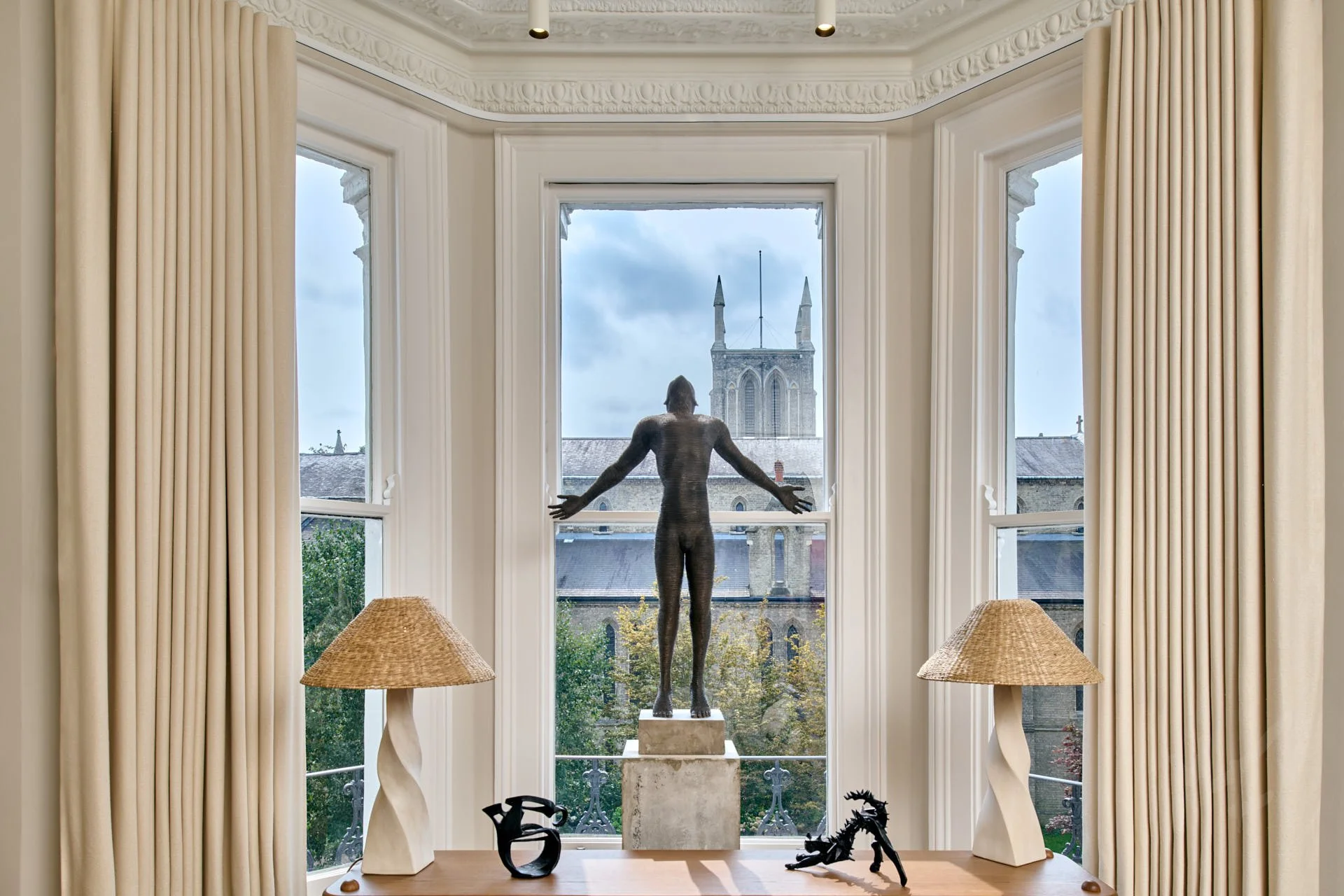
A folded textile can soften a hard composition. A plant can connect two planes of colour. A carefully positioned chair can make circulation easier to read. A few garments can turn joinery into a dressing room. Food and kitchenware can suggest hospitality without turning the kitchen into a set.
Each decision is small. Together, they create harmony.
The polished image is made through an unpolished process
On the shoot day, the property does not remain pristine from the first frame to the last.
Furniture moves. Boxes wait out of view. Props migrate between rooms. Lights and stands occupy spaces the camera cannot see. A chair may shift by a few centimetres because its relationship to a doorway matters from a particular viewpoint.
We assess the room through the camera, refine the composition, make a frame, then look again. The process continues until the architecture, interior design and signs of life support one another.
Once the final image is captured, the production still has another stage: resetting the property, recording purchased items, packing hired pieces and organising returns or collections.
The beautiful result depends on this less beautiful middle.
What should be agreed upon before a property shoot?
To ensure smoother production, settle these questions early:
-
A letting campaign, sales presentation, portfolio, press feature and brand story may require different decisions.
-
The room should speak to a recognisable audience, not an abstract idea of “everyone”.
-
Photograph rooms, cupboards and useful objects during the reconnaissance.
-
Agree the visual plan before sourcing begins.
-
One clear decision-maker prevents late and conflicting changes.
-
Include hire, purchase, delivery, collection, returns and stylist time.
-
Confirm keys, building rules, parking, lifts, protection and the condition in which the property must be left.
-
Usage, privacy and publication permissions should be explicit.
These questions do more than make the day efficient. They help the imagery perform its real role: enabling a viewer to understand the property, feel its character and imagine the life it can hold.
More than a beautiful room
The camera records what is placed in front of it. Our role is to decide what the frame needs to communicate.
That requires technical craft, certainly. It also demands spatial awareness, production planning, collaboration and sensitivity to how people read a room.
Often, the difference is not a dramatic transformation. It is a sequence of careful choices that make the property feel natural, coherent and quietly desirable.
The shoot begins long before the camera arrives.
When the preparation has been done well, the viewer never sees the effort. They simply understand the space.
Planning a property launch or portfolio update?
Speak to Marco Joe Fazio STUDIO before the day of the shoot.
We can help assess the space, define the visual story, and plan the required styling and production.
Credits
Client: Managed By
Commission: Still photography of three residential properties in Kensington and Holland Park, London
Production management: Geena Chohan
Creative direction and photography: Marco Fazio
Production design and styling: Tara Clark
Interior styling: Paul Cripps